
GLP-1 news report
GLP-1 pills are here—but the ‘more powerful’ pipeline is not a settled race
Oral Wegovy and Foundayo have changed how obesity medicines can be taken. Retatrutide, CagriSema, survodutide and zenagamtide sit at very different evidence and regulatory stages.
What the source reports
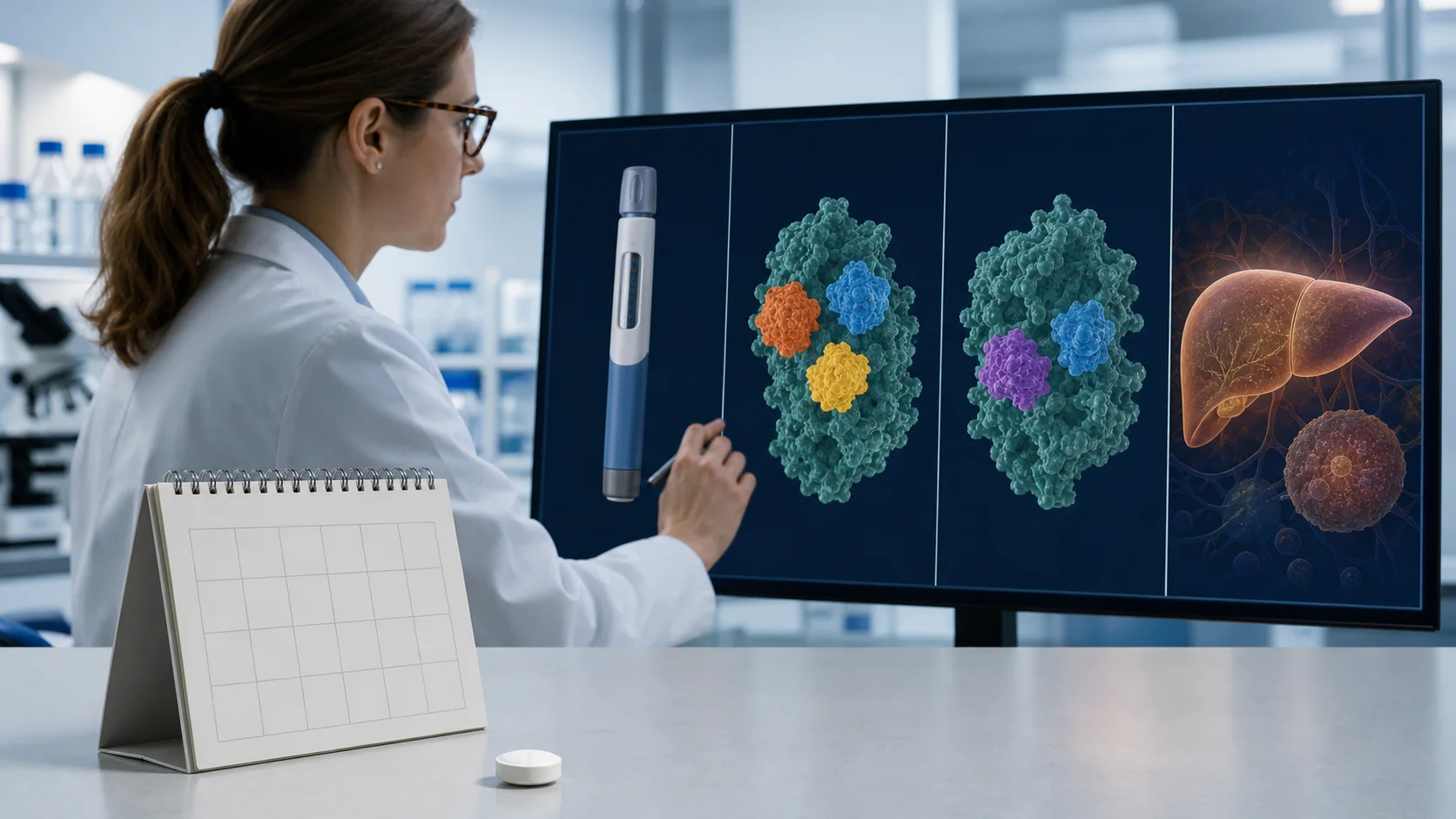
Obesity treatment is changing along two tracks. The first is practical: once-daily oral medicines have joined weekly injections. The second is experimental: companies are combining GLP-1 activity with GIP, glucagon or amylin pathways in an attempt to improve weight, metabolic outcomes or tolerability.
The two tracks should not be blurred. Oral Wegovy and Foundayo are approved products in defined markets. Retatrutide, CagriSema, survodutide and zenagamtide remain investigational as of 5 August 2026, even where Phase 3 trials have finished or a regulatory application has been filed.
It is also too early to declare one pipeline medicine more powerful than today’s treatments. Percentages from different trials use different populations, durations, doses and statistical assumptions, and are not substitutes for direct head-to-head evidence.
Oral Wegovy has US and EU approval—with specific timing rules
Once-daily Wegovy tablets containing semaglutide launched in the United States in January 2026. On 15 July, the European Commission granted marketing authorisation for the 25 mg tablet for adults with obesity, or overweight with at least one weight-related condition, alongside diet and physical activity.
European authorisation does not mean the tablets were immediately stocked or reimbursed in every member state. Novo said it planned launches in selected markets during the second half of 2026, so country-level availability still needs checking.
Oral semaglutide also has administration requirements. EMA says it is taken after at least eight hours of fasting, followed by a 30-minute wait before food, drink or other oral medicines. That is different from simply replacing a weekly injection with an unrestricted pill.
The latest verifiable US milestone is three million prescriptions—not five million
Novo reported on 7 June that US Wegovy-pill prescriptions had passed three million during the first five months after launch. The figure combined company internal data with prescription-market estimates and counts prescriptions, not unique people or confirmed doses taken.
We could not verify the claim that US prescriptions have already exceeded five million from a current Novo filing or announcement. Until a primary source publishes that milestone, three million is the defensible public figure.
Rapid prescription growth indicates commercial uptake, but it does not by itself show adherence, long-term outcomes, affordability or how many people continued treatment.
Foundayo removes the fasting requirement—but remains a prescription medicine
The US Food and Drug Administration approved Foundayo, the brand name for orforglipron, on 1 April 2026 for long-term weight management in defined adults alongside diet and physical activity. It is a once-daily, non-peptide small-molecule GLP-1 receptor agonist.
The FDA prescribing information says Foundayo can be taken with or without food. Unlike oral semaglutide, its instructions do not require an overnight fast or a 30-minute post-dose waiting period. That could make daily routines simpler for some people, but convenience is not the same as better adherence for everyone.
Foundayo still carries contraindications, warnings and adverse effects, and it should not be used with another GLP-1 receptor agonist. Its US approval should not be read as automatic approval or availability in other countries.
Retatrutide: the largest headline numbers, but still company-reported
Retatrutide is a once-weekly investigational medicine designed to activate GIP, GLP-1 and glucagon receptors. Lilly’s July Phase 3 topline announcement reported an average 20.8% body-weight reduction at 80 weeks with the highest dose in adults with type 2 diabetes and obesity or overweight, compared with 4.0% for placebo.
In a separate trial involving severe obesity and established cardiovascular disease, the highest dose produced an average 22.6% reduction, compared with 3.2% for placebo. These are substantial results, but the detailed Phase 3 datasets had not yet been presented at a medical meeting or published in a peer-reviewed journal when this article was prepared.
Descriptions such as ‘approaching bariatric surgery’ are cross-study comparisons, not evidence that retatrutide matches surgery for a particular person. Lilly plans a US submission in early 2027; that is not an approval date.
CagriSema: a filed GLP-1 and amylin combination
CagriSema is a once-weekly investigational injection combining semaglutide with the amylin analogue cagrilintide. Novo submitted it to the FDA in December 2025, but it was not approved in the United States or European Union as of 5 August 2026.
In REDEFINE 1, average weight loss at 68 weeks was 20.4% when analysed regardless of whether participants stayed on treatment, compared with 3.0% for placebo. Under the more idealised assumption that everyone remained on treatment, the estimates were 22.7% and 2.3%.
Those two estimates answer different questions and should not be mixed. Gastrointestinal events were common, and further trials are investigating cardiovascular outcomes, longer treatment and other populations.
Survodutide shows why ‘next generation’ does not automatically mean stronger
Survodutide activates GLP-1 and glucagon receptors and is being studied separately for obesity and liver disease. A peer-reviewed Phase 3 obesity trial involving 725 adults without diabetes reported average weight changes at 76 weeks of 12.2% with the 3.6 mg dose, 13.0% with the 6.0 mg dose and 5.4% with placebo under the main treatment-regimen analysis.
That result was statistically better than placebo, but it does not support a claim that survodutide has already outperformed established semaglutide or tirzepatide treatments. Gastrointestinal symptoms occurred in 80.9% and 89.7% of the survodutide groups, compared with 47.9% with placebo.
Separate Phase 3 programmes are studying metabolic liver disease, including MASH and MASH-related cirrhosis. An obesity result cannot be used to predict whether the medicine will improve liver-related clinical outcomes.
Amycretin and zenagamtide are the same programme—not two different drugs
Novo renamed amycretin as zenagamtide. It is a single investigational molecule designed to activate GLP-1 and amylin receptors, whereas CagriSema combines two separate molecules.
Phase 3 injectable zenagamtide studies are underway or registered across obesity and related conditions. Oral development is also planned and earlier oral studies have been completed, but an oral zenagamtide product is not approved and the available late-stage evidence is not yet comparable with an approved tablet.
The name change makes careful reporting important: listing amycretin and zenagamtide as separate pipeline medicines would double-count the same programme.
What remains uncertain
Retatrutide still needs full Phase 3 publication and regulatory review. CagriSema’s filed application could be approved, delayed or rejected, and its longer-term cardiovascular programme remains in progress.
Survodutide’s liver-outcome trials will run for years, while zenagamtide has not yet produced confirmatory Phase 3 obesity results. Oral development adds another uncertainty because efficacy, tolerability and dosing cannot simply be inferred from an injectable formulation.
We also do not know whether pills will replace injections for most people. Treatment continuation depends on more than route: adverse effects, daily versus weekly routines, price, supply, reimbursement and individual response all matter.
What this means for OurGLP1 users
A medication history increasingly needs more than the word ‘GLP-1’. Useful details include the exact brand and active ingredient, tablet or injection, prescribed strength, schedule, fasting instructions, start and stop dates, treatment gaps and the reason for any switch.
The difference between a daily pill and weekly injection may affect reminders and routines. It does not make formulations interchangeable: changing product, dose, timing or route remains a clinical decision.
Pipeline news should not prompt self-sourcing of investigational products. Trial medicines may have uncertain purity outside authorised research, and their benefits, risks and dosing are still being evaluated.
Bottom line
The oral shift is real. Wegovy tablets now have US and EU authorisation, while Foundayo offers a US-approved non-peptide tablet without oral semaglutide’s fasting routine.
The next-generation pipeline is more complicated. Retatrutide and CagriSema have produced large trial estimates, survodutide’s published Phase 3 obesity result was more modest, and zenagamtide’s oral and injectable programme still needs late-stage answers.
More mechanisms and larger headline percentages do not establish a winner. Approval, tolerability, discontinuation, long-term outcomes, access and direct comparisons will determine what these medicines actually add.
Primary sources
- European Commission approval of Wegovy pill for weight management in the EU — Novo Nordisk (accessed 2026-08-05)
- EMA recommendation and administration requirements for oral Wegovy — European Medicines Agency (accessed 2026-08-05)
- Wegovy pill prescriptions surpass three million in the United States — Novo Nordisk (accessed 2026-08-05)
- FDA approves Foundayo (orforglipron) for long-term weight management — US Food and Drug Administration (accessed 2026-08-05)
- Foundayo prescribing information — US Food and Drug Administration (accessed 2026-08-05)
- Retatrutide Phase 3 topline results from TRIUMPH-2 and TRIUMPH-3 — Eli Lilly and Company (accessed 2026-08-05)
- Novo Nordisk files CagriSema for FDA approval — Novo Nordisk (accessed 2026-08-05)
- Survodutide once weekly for the treatment of adults with obesity — New England Journal of Medicine (accessed 2026-08-05)
- LIVERAGE-Cirrhosis Phase 3 survodutide trial — ClinicalTrials.gov (accessed 2026-08-05)
- AMAZE 7 Phase 3 injectable zenagamtide trial — ClinicalTrials.gov (accessed 2026-08-05)
- Phase 1 oral amycretin study — ClinicalTrials.gov (accessed 2026-08-05)