
GLP-1 news report
Fake and compounded GLP-1 medicines: what the latest FDA and MHRA warnings show
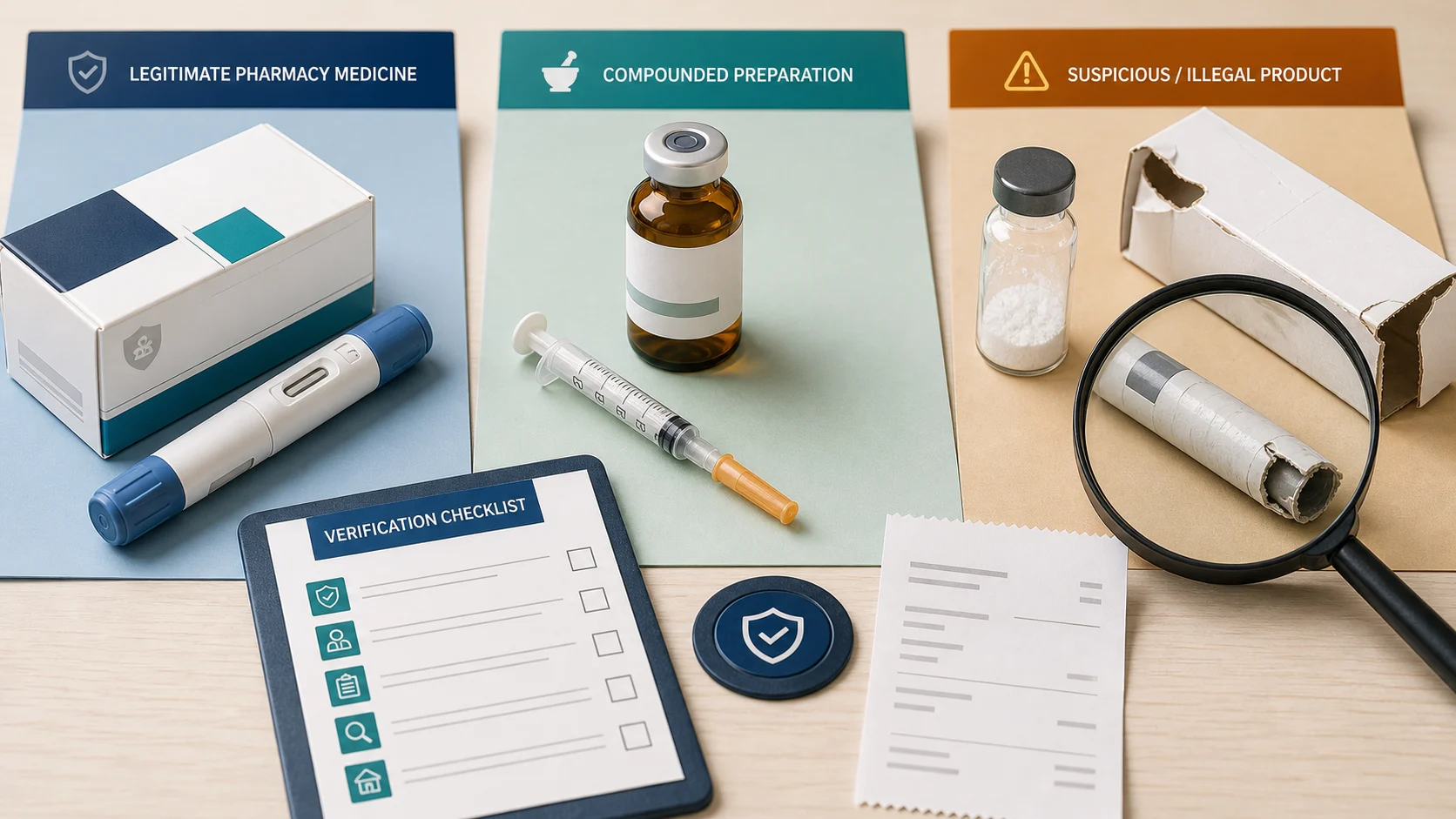
Compounded, counterfeit and illegally manufactured products are different—and reports involving them should not be presented as though they describe authorised branded medicines.
What the source reports
The US Food and Drug Administration says that, by 31 May 2026, it had received 990 adverse-event reports associated with compounded semaglutide and more than 730 associated with compounded tirzepatide. The regulator says some reports involved dosing errors, doses beyond approved product labels and symptoms serious enough to require medical attention.
In the UK, the Medicines and Healthcare products Regulatory Agency has issued repeated warnings about fake and illegally supplied weight-loss medicines. A February 2026 enforcement operation seized almost 2,000 doses of unauthorised products, suspected ingredients, packaging and manufacturing equipment from two premises.
The numbers describe different systems and different products. FDA reports concern US compounded preparations; the UK enforcement figure concerns suspected illegal manufacturing; and a counterfeit pen is a separate category again. Combining them into a single total would be misleading.
Four categories that should not be confused
An authorised branded medicine has been assessed by a regulator for safety, effectiveness, quality and manufacturing consistency for specified uses. Its approved packaging and patient information form part of that authorisation.
A compounded medicine is prepared by a pharmacy, physician or outsourcing facility for a clinical need under US compounding law. It can have a legitimate role when a patient’s needs cannot be met by an FDA-approved product, but the individual compounded product is not FDA-approved and does not undergo the same pre-market review.
A counterfeit product falsely claims to be an authentic medicine or misrepresents its identity or source. An illegally manufactured or unlicensed product may be sold under its own informal description rather than imitating a brand. Neither should be mistaken for lawful pharmacy compounding.
What the FDA figures mean—and what they do not
The FDA’s 990 and more-than-730 figures are spontaneous adverse-event reports associated with compounded products. The agency explicitly says it is not always possible to determine whether the product directly caused an event or whether other factors contributed.
The figures are also likely to be incomplete. Many state-licensed pharmacies that are not registered outsourcing facilities are not federally required to submit adverse-event reports to the FDA. At the same time, incomplete reporting means the totals cannot be converted into a rate without knowing how many people used the products and for how long.
Many reported events appear consistent with effects also associated with approved GLP-1 medicines, according to the FDA. The figures therefore signal a need for investigation and safer systems; they do not show that every event resulted from a compounding defect, and they do not describe adverse events from branded Ozempic, Wegovy, Mounjaro or Zepbound.
Why compounded injections can create additional dosing risks
Approved injection pens are designed to deliver specified doses. Some compounded semaglutide and tirzepatide products instead arrive in multi-dose vials that require a person to measure a volume with a syringe. Concentrations and instructions can vary between compounders.
The FDA has received reports in which patients measured the wrong amount and, in some cases, healthcare professionals miscalculated a dose. Confusion between milligrams, millilitres and syringe units can produce a much larger dose than intended.
The regulator has also received reports associated with prescriptions that used more product at one time, dosed more frequently or increased doses faster than the FDA-approved label. These concerns involve the preparation, concentration, instructions and prescribing process—not simply the GLP-1 molecule in isolation.
Semaglutide salt forms are another distinction
The active ingredient in FDA-approved semaglutide products is semaglutide in its base form. The FDA says some products sold by compounders may use semaglutide sodium or semaglutide acetate instead.
Those salt forms are different active ingredients. The agency says it does not have information showing that they have the same chemical and pharmacological properties as the ingredient in approved products and is not aware of a lawful basis for using them in compounding.
A label that uses the word semaglutide therefore does not, by itself, establish that the preparation contains the same active ingredient, formulation or quality controls as an authorised medicine.
US shortage rules have tightened
US compounding expanded while approved GLP-1 injections were in shortage. The FDA later determined that the national shortages of tirzepatide injection and semaglutide injection had resolved, ending temporary periods of enforcement discretion for routine copies.
As of its 1 April 2026 update, the FDA said neither semaglutide nor tirzepatide appeared on its drug-shortage list or the relevant list of bulk substances for section 503B outsourcing facilities. US law also restricts regular compounding of products that are essentially copies of commercially available approved drugs.
Compounding has not become universally illegal. A preparation may still meet legal conditions for an identified patient when a prescriber documents a change that produces a significant clinical difference, but a mass-market copy cannot be assumed lawful merely because it came through a telehealth advert.
Counterfeit pens are a separate problem
A counterfeit may copy a genuine carton, batch number or pen design. The contents can include too much, too little or none of the expected ingredient, another medicine, contamination or unknown substances.
In February 2026, the MHRA contacted certain patients after fake Mounjaro 15 mg pens were identified from one UK pharmacy. Testing found tirzepatide in the pens, but the unknown manufacturing conditions meant the regulator could not confirm that the contents were sterile. It assessed the risk to people who had already used the identified pens as low based on the cases reviewed at that time.
The World Health Organization has previously documented falsified Ozempic batches in the Americas and Europe, including the UK. That alert illustrates why a familiar-looking brand, batch number or pre-filled pen cannot prove authenticity when the supply route itself is uncertain.
The UK position is different from US compounding
All GLP-1 medicines in the UK are prescription-only. The MHRA says a private supply still requires a consultation and prescription from a healthcare professional, followed by dispensing from a legitimate pharmacy.
The regulator says authorised GLP-1 products are supplied as pre-filled pens or tablets. Products sold as powder in a vial that must be mixed before injection are not authorised in the UK and pose significant risks. This is not the same regulatory pathway as patient-specific US pharmacy compounding.
The MHRA’s February enforcement operation found suspected illegal products including tirzepatide and retatrutide. Retatrutide remains experimental and is not authorised in the UK; a website or social-media seller cannot turn an investigational substance into an approved medicine by calling it a peptide or research product.
What official warnings say to look for
The FDA lists several telehealth warning signs: claims that a compounded preparation is identical to an approved drug, unusually deep discounts, damaged packaging, missing instructions, incorrect pharmacy addresses and supply without screening or a prescription from a licensed clinician.
For UK readers, the MHRA says the reliable route is a prescription followed by supply from a registered pharmacy. Great Britain’s pharmacy register is maintained by the General Pharmaceutical Council, while Northern Ireland uses the Pharmaceutical Society of Northern Ireland register.
Unexpected packaging, a product different from the one prescribed, powder requiring home mixing, a faulty pen or an offer made entirely through social media warrants verification with the dispensing pharmacy. Suspected counterfeit products and side effects can be reported through the MHRA Yellow Card scheme.
What remains uncertain
The FDA figures do not provide an event rate or a controlled comparison with approved products. Public data do not consistently reveal which reports involved a lawful patient-specific preparation, a poor-quality compounded product, a dosing mistake, a fraudulently labelled product or several contributing factors.
Illegal-market activity is also difficult to count. Seizures show that production and trafficking exist, but they cannot measure the total number of products reaching consumers or the proportion that contain the claimed ingredient.
Better denominator data, consistent product testing, clearer identification of the compounder and more complete adverse-event reporting would help separate risks caused by the active medicine from those caused by concentration, sterility, instructions, fraud or illegal manufacture.
What this means for the individual
A report about compounded or counterfeit GLP-1 products does not automatically change the safety evidence for a genuine medicine supplied against a valid prescription. The source, formulation and dispensing route are part of the safety question.
Someone uncertain about a product can retain the carton, pen or vial, dispensing label, receipt, prescriber details and photographs of any fault. Those details help a pharmacist or regulator identify what was actually supplied without relying on a brand name alone.
OurGLP1 can record a medicine name, dose and symptom timeline, but it cannot authenticate a product or assess sterility. Product verification belongs with the dispensing pharmacy, manufacturer and medicines regulator.
Bottom line
The FDA’s adverse-event totals are important, but they apply to reports associated with compounded semaglutide and tirzepatide—not automatically to approved branded products. The reports are incomplete and do not prove causation in every case.
Counterfeit pens and illegally manufactured vials create different risks again, including unknown contents, concentration and sterility. Accurate coverage should identify which category is involved before attaching a safety headline to ‘GLP-1 drugs’ as a whole.
Primary sources
- FDA’s concerns with unapproved GLP-1 drugs used for weight loss — US Food and Drug Administration (accessed 2026-08-10)
- Understanding the risks of compounded drugs — US Food and Drug Administration (accessed 2026-08-10)
- FDA clarifies policies for compounders as national GLP-1 supply begins to stabilize — US Food and Drug Administration (accessed 2026-08-10)
- GLP-1 medicines for weight loss and diabetes: what you need to know — Medicines and Healthcare products Regulatory Agency (accessed 2026-08-10)
- No summer shortcut for safe weight loss — Medicines and Healthcare products Regulatory Agency (accessed 2026-08-10)
- MHRA disrupts second manufacturing facility suspected of illegal weight-loss medicine production — Medicines and Healthcare products Regulatory Agency (accessed 2026-08-10)
- Fake Mounjaro (tirzepatide) KwikPen 15mg pre-filled pens — Medicines and Healthcare products Regulatory Agency (accessed 2026-08-10)
- Medical Product Alert N°2/2024: falsified Ozempic (semaglutide) — World Health Organization (accessed 2026-08-10)